Showing posts with label cadence. Show all posts

Thursday, January 5, 2012

Biomechanics: Efficient Runner Model Rev 1.1

Mathematical Analysis utilizing biomechanics and basic physics can be used to determine the energy cost of various running factors. When the energy cost is known and compared to empirical data the time penalty associated with these factors can be determined. Running variables, combinations thereof, and their effect on performance that can be readily analyzed include:

Shoe weight
Shoe cushion & heel to forefoot differential
Over-stride/cadence
Excess body weight
Foot strike


This post establishes the basic model that will be used for the separate analysis of each of these factors. Assumptions and initial conditions are also defined. This is a crude model intended to capture the gross movements, which account for the majority of energy cost.  This update from Rev 1.0 modifies the figure to clarify center of mass position relative to foot strike and adds the parameters and calculations used to determine the energy cost of striding and vertical displacement.

A visual examination of efficient runners was necessary to create a proper model. An optimal stride was found to be one that places the center of mass directly over a slightly bent knee when the foot strikes. Cadence is equal to or greater than 180 foot strikes per minute and a forefoot strike is employed
.  Both low cadence (over stride), and the use of a heel strike reduce efficiency.1  

The two gross movements which constitute the majority of energy expenditure are striding and vertical displacement.

Striding
For each stride the foot is accelerated up and forward requiring energy. The energy cost of striding can be calculated using Newton’s laws of motion and by treating the legs and shoes as point masses. For these calculations the leg was divided into separate masses consisting of the shoe, foot, calf, and thigh. Examination of a stride reveals the respective distance each point mass travels with respect to the hips.


The mass contributions m were found in percent total body weight with respect to one limb.  The horizontal distance  ∆dh  traveled was found as a percentage of stride length L.  The vertical distance ∆dv traveled is a percentage of total body height. 2
 

m [%]
∆dh [%]
∆dv [%]
Thigh
6.7
15.4
-
Calf
2
46
-
Foot
2
100
26.7
Shoe
-
100
26.7

When the pace and cadence are known the stride length L and acceleration a of each point mass can be readily determined.

L = 1/(pace•cadence)
a =  2∆d/t2

When acceleration is known the force F required to accelerate each point mass can be found.  Energy E is then calculated for each point mass, summed, and converted to food Calories.

F = ma
E = F∆d

As the total striding energy is calculated per stride it must be multiplied by cadence and optionally pace to place it in terms of either time or distance respectively.  Dividing by 4184 will convert Joules to food calories.  When analyzing striding, the power generated to push off the ground is ignored, as it is captured by the center of mass and conversion of energy calculations.

Center of Mass and Conservation of Energy:
The energy cost related to center of mass displacement can be calculated using a spring mass model and Hooke’s law.  The center of mass mC follows the dashed sinusoidal path of amplitude ∆h.  When cadence is known ∆h can be readily calculated using equations of motion. 

∆h = ½(9.8)(tSTRIDE/2)2

The vertical component of the Kinetic energy of the runner can be calculated when the height is known.  This is the energy of each foot strike EK.

EK = (mC)(9.8)( ∆h) 

Additionally the shoe, foot, leg, and torso can all be modeled as one equivalent spring or separate springs in series.  Here the leg is treated as one equivalent spring.
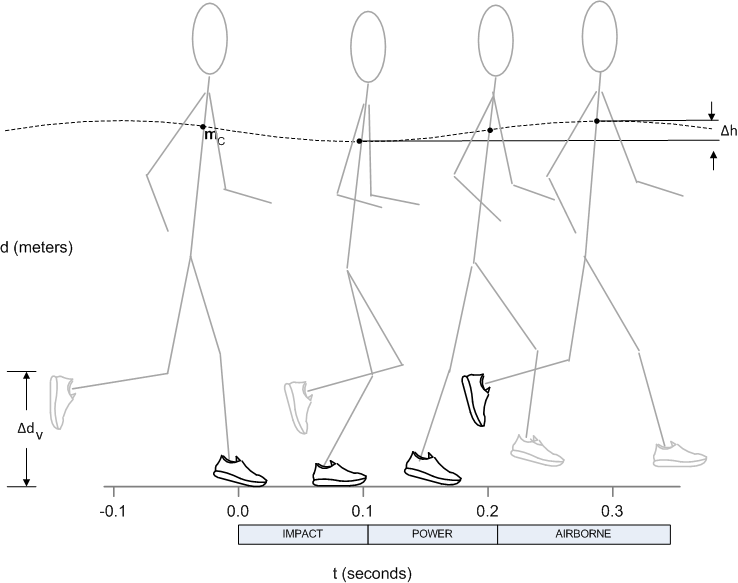


Central to calculating center of mass energy costs is the conservation of energy.  Each stride transfers some energy to the next, loses energy to the environment, and adds additional energy from muscle contractions.  To find the energy the leg captures ELEG the spring constant of the leg must be known or the force exerted on the spring at its maximum compression must be known.  From the work of Lieberman the force is known to be 2.5 body weight.

ELEG = ½ (F)(mC)(9.8)(½∆h)    


To maintain a steady pace the energy lost to the environment is equal to the propulsive energy of muscle contractions.  The energy expended to maintain vertical movement EV is thusly:

EV = EK - ELEG

Once again, as the vertical energy is calculated per stride it must be multiplied by cadence and optionally pace to place it in terms of either time or distance respectively .  Dividing by 4184 will convert Joules to food calories.  The total energy cost of running is the sum of the striding and center of mass calculations.

*

1 The gross movements for a heel strike and forefoot strike were found to be the same, notable differences exist in the impact forces.  The stride time tSTRIDE can be calculated by  dividing 60 seconds by cadence.
2 Mass and height contributions are for a 5’8” 145lb 10.7% body fat male.

*

Please feel free to refute any part of this post or add detail that has been missed.  While my intent is to fully explain things I do not always succeed and some nuances have been omitted in the interest of brevity.  I am happy to discuss in further detail as required.

Wednesday, November 9, 2011

Run Faster: Cadence/Over-stride and Performance

Over striding is the single largest factor in preventing runners of all skill levels from reaching their full potential.  Increasing efficiency by way of employing an optimal stride can cut minutes from race times.  Energy is needlessly wasted when over striding by two mechanisms:
  1. The leg is prevented from functioning like a spring by storing and transferring energy from one stride to the next
  2. Energy is lost to greater vertical displacement. 
This topic transcends foot strike as shod or minimalist heel and forefoot strikers are all plenty capable of over striding and the resulting inefficiency and reduction in sustainable pace that comes with it.


An over striding runner at left contrasted with an optimal stride at right.  Greater vertical displacement of an overstride can be seen by the relative magnitude of the arrows.


An over stride occurs when the center of mass is behind the knee when the foot strikes.  In extreme examples the leg is straight when the foot strikes as seen displayed by the runner at the left.  An optimal stride is one that places the center of mass directly over a slightly bent knee when the foot strikes as seen displayed by the runner on the right.

Over stride and efficiency are directly related to cadence.  Cadence being defined as the number of right or left foot strikes in a 60 second period.  An over stride / reduction in efficiency occurs at any cadence less than 90 as cited in numerous studies and is easily verifiable by an increase in perceived effort, heart rate, and calorie burn.  An optimal cadence of 90 is employed for much of the human endurance range of paces.  Even faster paces require higher cadences as stride length has a maximum.


My personal pace and cadence curve.  The endurance range of paces is a constant 90.  Outside of the endurance range speed is increased by increasing cadence.
         
Stride length reaches a maximum at sprint speeds.

Personal cadence made possible by ANT+ foot pod and compatible watch.  .  A foot pod is an underrated but indispensible training tool.

The effect of even a slight over stride on race times of all distances is profound.  Much of the year I employed a cadence of 86 preventing me from realizing my full potential.  A cadence of 90 could have shaved 56 seconds from a 5k, and close to 5 minutes from a half marathon for the paces in the table.  For the most severe over stride the potential is even greater at 3 minutes for a 5k and close to 17 minutes for a half marathon.  As paces slow efficiency decreases when over striding       

Distance
Actual Pace
Potential Pace
76 cadence
86 cadence
90 cadence
5k
6:00
5:01 (-59s)
5:42 (-18s)
6:00
10k
6:20
5:16 (-64s)
6:01 (-19s)
6:20
15k
6:25
5:20 (-65s)
6:05 (-20s)
6:25
½ marathon
6:55
5:39 (-76s)
6:33 (-22s)
6:55

The potential pace in the table indicates what pace could be realized by employing an optimal cadence of 90 if the actual pace were ran in the time listed at the cadence listed.  For a cadence of 90 no improvment is possible and the potential pace equals the actual pace.  To further explain the mechanisms mentioned at the beginning of the post:
Spring Effect:
A running human creates a good amount of kinetic energy.  Running is the closest to flying our bodies get and each stride does include an airborne portion.  The leg can capture much of the energy (63% at 90 cadence) from the vertical displacement that accompanies coming back to earth and apply that energy to the next stride.  The bones and tissue of the human foot and leg form a very functional and efficient spring.       
An over striding runner will not fully benefit from the legs ability to function as a spring.  Instead of the leg capturing and transferring this energy to the next stride some or all of that energy will be violently dissipated in the form of noise and vibration/deformation of the shoes, feet, muscle, and bones.  Run quietly is apt advice.  The next stride will need to generate this energy again requiring additional effort (0 to 16.5% + of total energy expenditure).
Vertical Displacement:
If the spring effect were not offensive enough over striding also requires greater vertical displacement, which sub sequentially requires greater effort to accomplish.  Coming from greater heights also leads to greater impact forces.  It is often repeated that races are a straight line, not up and down, thus in the interest of speed it is best to minimize vertical movement.  This effect is secondary as it causes much less energy loss than losing out on the previously mentioned spring effect.  A small amount of energy is saved from striding less but is does not change the net result.
 *
The popularity of Run Faster:  Shoe Weight and Performance helped inspire this post.  If you enjoyed this post +1, forward it to a friend, or leave a comment.  Feedback keeps me motivated.  Additionally the topic is rich and I am happy to discuss.  If you hated it or see inaccuracies, let me know too.  This post was made possible by way of mathematical analysis utilizing basic physics and efficient runner model rev 1.0.  A follow up post will contain the analysis for the select few.  If you are interested in reading more on the topic this link contains great material.  Thanks for reading.
NOTE:  An optimal cadence of 180 refers to both the left and right foot strikes in a 60 second period.  An optimal cadence of 90 refers to just the left or just the right foot strikes in a 60 second period.  Different device manufacturers and authors use either or.